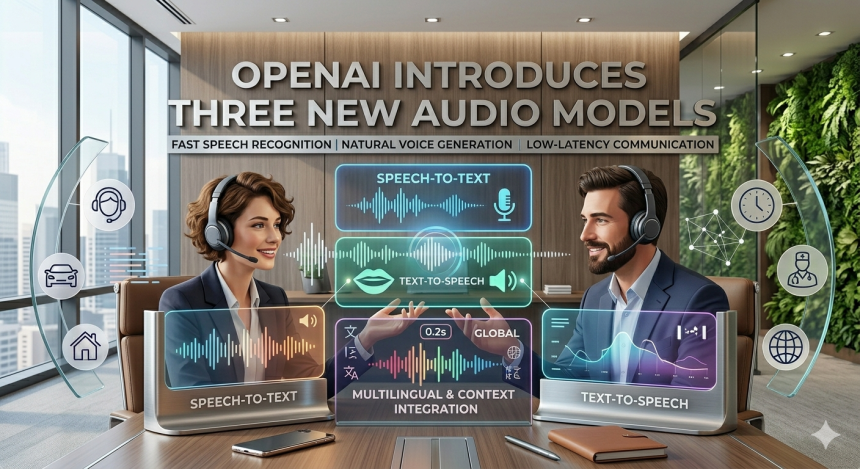
OpenAI has introduced three new audio models designed to power real-time voice interactions, marking another major step forward in conversational artificial intelligence. The new models focus on faster speech recognition, more natural voice generation, and low-latency communication, allowing AI systems to interact with users in a more human-like way.
The announcement comes as the demand for voice-enabled AI applications continues to grow across industries including customer service, smart devices, healthcare, automotive technology, and enterprise software. With businesses increasingly adopting AI-powered assistants and live transcription tools, real-time voice technology is quickly becoming one of the most competitive areas in artificial intelligence.
OpenAI’s latest audio models are built to improve both speech-to-text and text-to-speech capabilities. The company says the models can better understand spoken language in noisy environments while generating smoother and more natural sounding responses. Reducing delays during conversations is also a key priority, helping AI systems respond almost instantly during live interactions.
The launch highlights the broader industry shift toward multimodal AI systems that combine text, audio, video, and image understanding into a single experience. Voice AI is expected to play a major role in the future of digital assistants, wearable technology, smart homes, and connected vehicles.
Developers will be able to use the new models to build applications such as AI customer support agents, meeting transcription platforms, live translation services, virtual assistants, and interactive voice experiences. Improved multilingual support and contextual understanding could also make these tools more useful for global audiences.
As competition intensifies in the AI sector, major technology companies are investing heavily in conversational AI that feels more natural and responsive. OpenAI’s new audio models position the company to compete aggressively in the rapidly expanding voice AI market.
The release signals that the future of AI is moving beyond text-based chatbots toward real-time spoken interaction, where users can communicate with machines as naturally as they would with another person.