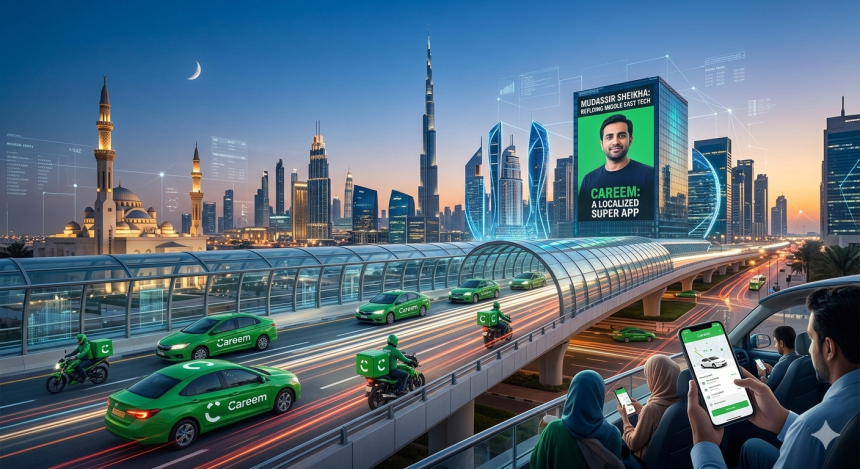
In recent years, the Middle East has emerged as one of the fastest-growing technology ecosystems in the world. At the heart of this transformation are entrepreneurs who are not just building startups, but redefining how business is done across the region. One of the most impactful stories comes from Mudassir Sheikha, a name that has become synonymous with innovation in the Middle East.
Before launching his company, Sheikha identified a clear gap in urban mobility across cities like Dubai, Riyadh, and Cairo. Transportation options were often inconsistent, and there was a lack of reliable, tech-driven solutions tailored to the region’s unique needs. Instead of importing a global model, he chose to build something locally relevant.
This vision led to the creation of Careem in 2012 a ride-hailing platform designed specifically for the Middle East. But Careem was never just about getting from point A to point B. It focused heavily on localization, offering features like cash payments, Arabic language support, and customer service tailored to regional expectations key factors that helped it gain rapid adoption.
The journey, however, was far from smooth. Building a tech company in the region at that time meant navigating limited funding ecosystems, regulatory challenges, and varying market dynamics across countries. Scaling across multiple cities required not just technology, but deep operational understanding and adaptability.
What set Careem apart was its ability to evolve. The company expanded beyond transportation into a “super app,” offering services such as food delivery, digital payments, and logistics. This shift reflected a broader vision: to become a daily-use platform that simplifies life for millions of users.
Technology played a central role in this growth. By leveraging data analytics, mobile platforms, and scalable infrastructure, Careem was able to optimize routes, improve customer experience, and efficiently manage operations across diverse markets. It wasn’t just a startup it became a regional tech powerhouse.
In 2019, Careem reached a historic milestone when it was acquired by Uber for $3.1 billion, marking one of the largest tech exits in Middle Eastern history. The deal was more than just a financial success it was a signal to the world that the region could produce globally competitive tech companies.
Today, Mudassir Sheikha’s journey stands as a blueprint for aspiring entrepreneurs in the Middle East. It highlights the importance of building solutions that are deeply rooted in local realities while maintaining a global vision. It also underscores the power of persistence, adaptability, and long-term thinking.
As the region continues to invest in technology, innovation, and entrepreneurship, stories like Careem’s are no longer exceptions they are becoming the foundation of a new digital economy.
For the next generation of founders in the Middle East, the message is clear: the opportunity is here, the ecosystem is growing, and the time to build is now.