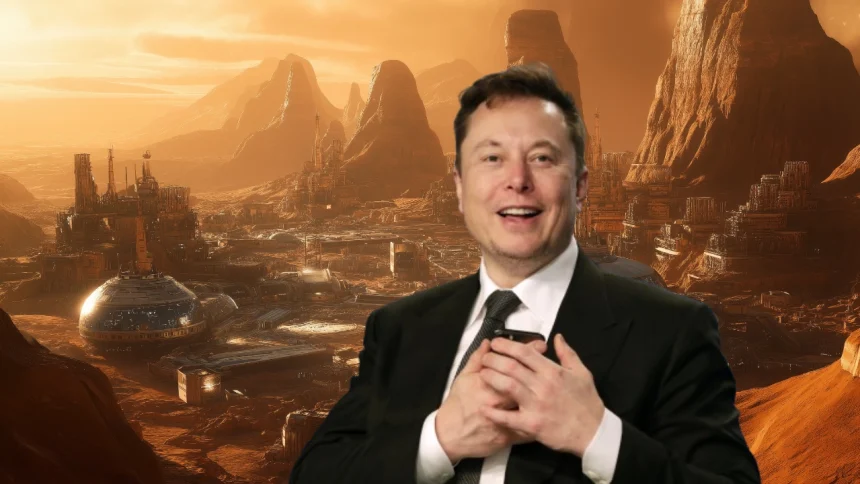
Elon Musk has revealed SpaceX’s ambitious plan to create a self-sustaining city on Mars within the next 20 years, building on the recent success of their first fully reusable rocket stage. In a post on X (formerly Twitter), Musk highlighted the critical need to reduce the cost of sending payloads to Mars from $1 billion to $100,000 per ton, describing this challenge as difficult but achievable.
Musk announced that the initial Starship missions to Mars will launch in two years during the next Earth-Mars transfer window, initially without crew, to ensure reliable landings. If these test flights are successful, crewed missions could follow in four years. He stated, “Flight rates will grow exponentially from there, with the ultimate aim of establishing a self-sustaining city in about two decades.”
Musk emphasized the importance of becoming a multiplanetary species for the long-term survival of consciousness, suggesting that this would help safeguard humanity by not relying solely on one planet.
Regarding Mars’s potential for human habitation, SpaceX noted its proximity to Earth—averaging 140 million miles away—as well as its adequate sunlight, despite being farther from the Sun. The company pointed out that Mars has a primarily carbon dioxide atmosphere, making it possible to grow plants by compressing the atmosphere, and highlighted that its gravity is about 38% that of Earth’s, allowing for easier mobility. The length of a day on Mars is also quite similar to that of Earth.