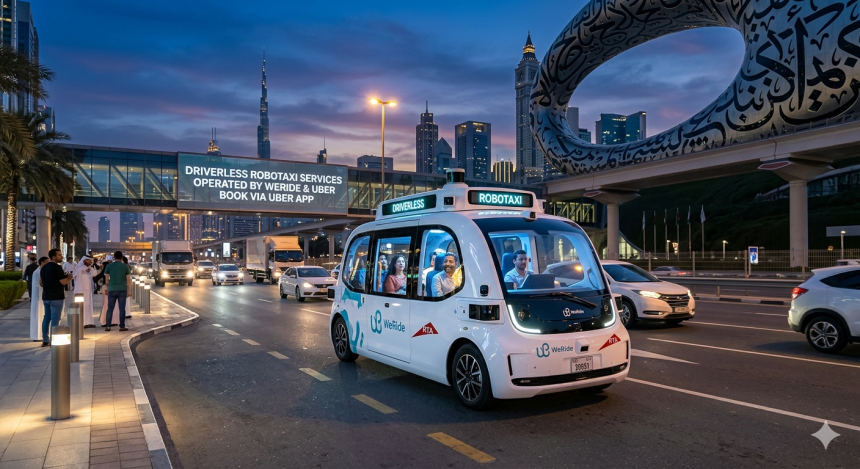
Dubai has taken a decisive step into the future of mobility with the launch of fully driverless, fare-charging robotaxi services by WeRide and Uber. The rollout marks a significant milestone not only for the UAE but for the global autonomous vehicle industry, as the emirate transitions from pilot testing to real-world commercial deployment.
Introduced in collaboration with Dubai’s Roads and Transport Authority (RTA), the service allows users to book autonomous rides directly through the Uber app. By selecting the “Autonomous” option, passengers can experience a fully driverless journey across key districts, including high-traffic urban and lifestyle areas. The initiative reflects Dubai’s commitment to integrating advanced technologies into everyday life while enhancing convenience for residents and visitors.
This launch represents a critical evolution from earlier trials, where safety operators were present behind the wheel. The shift to fully driverless, paid operations signals growing confidence in autonomous systems and their ability to safely navigate complex city environments. Powered by advanced artificial intelligence, real-time data processing, and a network of sensors including LiDAR and cameras, the robotaxis are designed to respond dynamically to traffic conditions and ensure a smooth passenger experience.
The move is closely aligned with Dubai’s ambitious vision to become a global leader in smart mobility. Under its long-term strategy, the city aims to convert 25 percent of all transportation journeys into autonomous trips by 2030. The introduction of commercial robotaxi services is a major step toward achieving this goal, reinforcing the emirate’s position as a testing ground for next-generation transport solutions.
Beyond Dubai, the partnership between WeRide and Uber is part of a broader regional expansion that is expected to accelerate in the coming years. With plans to scale operations across major Middle Eastern cities, the initiative highlights the region’s readiness to adopt cutting-edge mobility solutions, supported by forward-thinking regulations and robust infrastructure.
For users, the experience is designed to be seamless and familiar. From booking to drop-off, the journey mirrors a traditional ride-hailing service except for the absence of a human driver. This not only reduces operational costs over time but also opens the door to increased efficiency, improved safety through reduced human error, and potentially lower fares as the technology matures.
As autonomous mobility continues to gain traction globally, Dubai’s latest move sets a powerful precedent. The launch of fully driverless, fare-charging robotaxis is more than a technological breakthrough it signals a fundamental shift in how cities approach transportation. With innovation at its core, Dubai is once again positioning itself at the forefront of the future.4